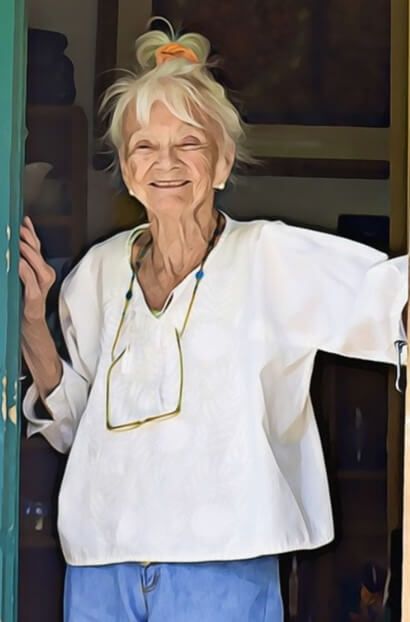
Jamie Lovene Musser
Obituary
Jamie Lovene Musser, born November 7, 1931, in San Francisco, lived in Chico from 1970 until her passing on June 13, 2024, at the age of 92. Jamie is best known for her iconic shop, “Lovene’s Vintage Clothing & Collectibles”, opened in 1976 in the front rooms of her charming Victorian on East 9th Avenue in Chico. After nearly 50 years, the shop had its final sale in January 2024. Jamie had an eye for collecting and also created new garments from old, pioneering the concept of “upcycling” on her beloved 1963 Necchi Supernova, a prized Italian sewing machine that became more vintage than the clothes in her store. Yet, like her, was vibrant and going strong.
Jamie’s passion for sewing began as a teen. Her first professional sewing venture was in 1951, with her childhood friend, Barbara (Bullard) O’Connor. Together, they created full-height dancing dolls made of cotton duck stuffed so tightly with batting that the dolls could stand upright. Each doll, with its own hair, face, and clothing, had a unique personality. They brought a few to I. Magnin’s in San Francisco’s Union Square and the manager was so smitten he twirled through the store with one of the dolls and proceeded to order a menagerie. The two friends described sewing so furiously that their machines would smoke.
With a B.A. in Fine Art from Chico State University, Jamie was a bohemian artist extraordinaire. Her mainstay was fashion design—of which her inimitable personal style cannot be overstated. She was also known for her vibrant oil paintings, pen and ink illustrations, and for a lucky few, her letters. She had natural talent in anything she put her hand to: weaving, block printing, hatmaking, to name a few. Her “psychedelia” illustration of the 1972 book, “Togethering in Happyland,” now out of print, showcases her world-class skill in pen and ink.
At the same time Jamie was creative and norm-breaking, she was upright and self-reliant. She never bounced a check in her life, and her accounting ledgers are marvels of precision. Jamie supported herself with a career in histology, the science of preparing tissue slides for pathology—also requiring marvels of precision. She began her career in the Bay Area at Kaiser and retired from Pathology Sciences in Chico. Her skill in the labs remains legendary.
Jamie forged deep and epic friendships, some sustained via hundreds of letters exchanged over decades. She continued to attract meaningful relationships to the very end, touching souls with her delightful wit, magnetism, and style. Jamie eschewed television and had an insatiable love for books, film, and newspapers. She was a regular at the library, art shows, and thrift shops, and went to the gym till she was 90.
Jamie’s path diverged from the 1950’s stereotype (Sequoia High School Class of 1950), in part due to doctors using unrestrained X-rays to examine her childhood appendicitis, rendering her unable to bear children. Then, at age 14, her beautiful mother died after a long battle with cancer. Jamie had two brief marriages, one dull, one incendiary, followed by a decades-long “it’s complicated” relationship, in which she refused to marry or cohabitate.
Inheriting a rich family legacy, Jamie was the second child of mother, Helen Mary Whitelock from Missouri, a milliner who financed her husband’s dental school by designing and making hats, and father, Luzon Rizal Musser, said dentist, born in the Philippines to writer and adventurer, Don Carlos White Musser, who founded the first English-language newspaper in the Philippines.
A step deeper, Jamie’s great grandfather, Amos Milton Musser, was a pioneer of the Mormon Church in Salt Lake City He was associated closely with Brigham Young and Joseph Smith, and the building of the Mormon Temple. Amos Musser’s photo is prominent in historical accounts of the criminalization of polygamy, often posing proudly in striped prison garb. According to the massive archival collection on the Musser Family owned by the Utah State Historical Society, Amos was responsible for introducing the telephone, phonograph, and first rail line through Utah, and was head of Fish and Game. However, Amos’ son, Don Carlos White Musser, (Jamie’s grandfather who went to the Philippines), was excommunicated over disagreement with Mormon principles, so Jamie grew up two generations removed from Mormonism.
Jamie’s parents moved their young family from San Francisco to Redwood City where Jamie spent childhood with her brother, Don Carlos. It was he who dubbed her Miss Muffett due to her fairy-like features. The nickname fit, with many refusing forever to call her anything but Muffet or Muff.
At 91, Muff’s independent lifestyle halted abruptly. Her worst nightmare. Instead of complaining, she recalibrated her end-game with sophistication and grace. In her final months, she was profoundly grateful for her life and set her mind toward the next great adventure.
Jamie outlived her family by decades. Her mother departed from cancer in 1945 (nearly 80 years ago), her cherished older brother, Don Carlos, died in his forties (nearly 50 years ago), and her father and loving stepmother, Julia, both died in the 1980s (about 40 years ago). So it is after all these decades, that Jamie joins her family in the Musser niche at Cypress Lawn Memorial Park in Colma, California.
Dearest Muff, Dearest Jamie, You thrilled us, you inspired us. Being around you was a delight. Thank you for taking us outside the box, making us laugh, making us think, making us better. Your friends cherish you forever and wish you every good thing. We love you.